

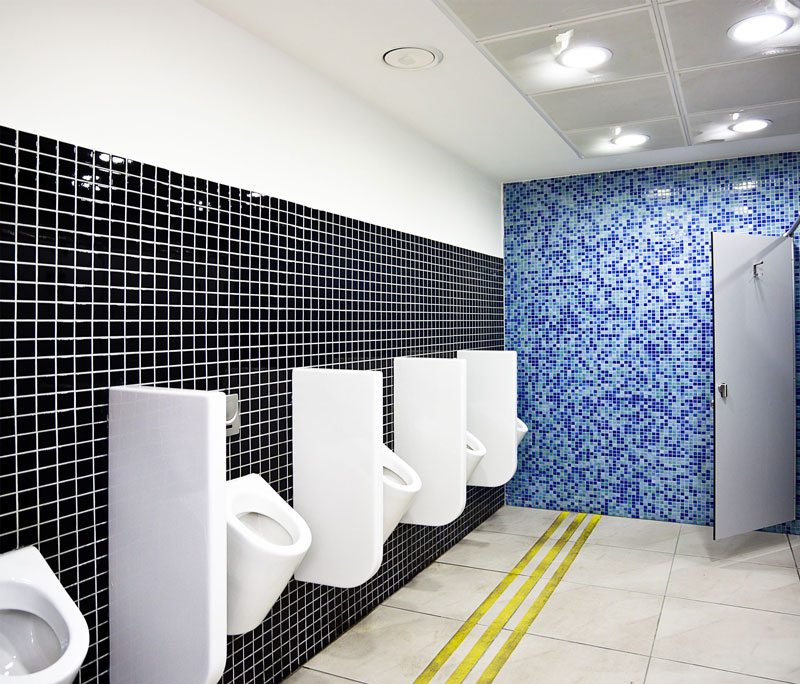
Commercial flushometer valves — the chrome diaphragm or piston valves you see on every commercial toilet and urinal — handle a workload no residential toilet ever sees. Hundreds or thousands of flushes per day, in a Southern California water supply that delivers minerals at a rate that destroys consumer-grade hardware in months. When a flushometer fails, the symptoms run from a constant trickle to a flush that never stops, and the water bill consequences add up fast.
Here is how commercial flushometers actually work, why they fail in Southern California specifically, and what facility managers should expect from a service program.
Diaphragm vs piston flushometers
The two dominant designs in Southern California commercial buildings. Diaphragm flushometers use a rubber diaphragm to control flush timing and volume. Piston flushometers use a metal piston in a sleeve. Both serve the same function but fail differently.
Diaphragm valves are easier to service in the field — a worn diaphragm is a $15 part and a 20-minute repair. Piston valves last longer between services but require more substantial repair when they do fail.
Why hard water destroys flushometers
Most Southern California water districts deliver water with 15-25+ grains per gallon of hardness. The minerals build up on every wetted surface inside the valve — diaphragm seats, piston sleeves, control orifices. Within months, the buildup interferes with proper sealing and flow control. The valve either runs continuously or shuts off prematurely.
The EPA WaterSense commercial guidance tracks how undetected fixture leaks compound across portfolios. A single failed flushometer running continuously wastes 30-50 gallons per hour — 700-1,200 gallons per day, 365 days a year if nobody catches it.
Common failure modes
Constant flush (valve will not shut off): usually a torn diaphragm or a piston seal that has failed. Field-repairable.
Short flush (valve shuts off too quickly): usually mineral buildup in the control orifice. Clean or replace the diaphragm/piston.
No flush (handle does nothing): typically the handle linkage or the relief valve. Inexpensive part, quick fix.
Slow refill (next flush is weak): usually low supply pressure or a partially closed angle stop above the valve.
Service intervals
Most commercial flushometers benefit from a full rebuild every 5-7 years and a diaphragm/piston replacement every 2-3 years for high-traffic units. Schedule the rebuilds during off-hours so the restroom does not go out of service during business hours.
Adjacent restroom items worth bundling
When the plumber is already in the restroom for flushometer service, address the rest of the maintenance items in one visit. Replace deteriorated wax rings, tighten flange bolts, lubricate angle stops, and inspect supply lines.
For restrooms that have had water exposure incidents — sink overflows, supply line bursts, toilet leaks — the floor finishes often need professional attention. Specialized commercial carpet and tile cleaning services handle the porous-surface side that develops odor and staining from chronic moisture exposure. For larger commercial flooring scope, deep-clean commercial steam cleaning services address full-floor recovery.
Documentation and water loss tracking
For commercial portfolios, track which fixtures get serviced when. A history of repeated failures on the same fixture often points to a supply-side issue (high pressure, water hammer) rather than the valve itself.
Your Southern California Commercial Flushometer Specialists
At Pacific Coast Elite Plumbing, we service and replace commercial flushometers across Southern California — single buildings to multi-property portfolios. Contact us to schedule preventive service. Our commercial plumbing services cover the full Southern California region.